

Keep the first lesson concrete
Choose one familiar situation, such as picking one item at a pretend shop or deciding what to do with a pretend coin. Explain what is happening in simple words, then let the child talk or point to a choice.
A child does not need to memorize coin values or make real spending decisions for this activity to be useful. Treat questions and conversation as the work of the lesson.
Try a short pretend-coin activity
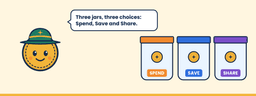
Use large paper circles, picture cards, or another safe pretend token. Keep the activity on a table with an adult and use a small set of pretend coins rather than a child’s real money.
- Earn It: talk about a helpful job an adult has chosen, such as sorting picture cards together.
- Spend It: invite the child to choose one picture from two pretend shop choices.
- Save It: draw a simple goal and put a pretend coin beside the picture.
- Share It: choose a pretend way to help someone, such as drawing a card for them.
Use questions that leave room for an answer
Ask one question at a time and accept a spoken answer, a gesture, or a drawing. Avoid turning the activity into a quiz about getting the “right” choice.
- “What would you like to choose?”
- “What might we do if we want to wait for something?”
- “Who could we help with this idea?”

Let the adult carry the money details
For real purchases, saving plans, and family rules, the adult makes and explains the decisions. Keep the child’s activity on paper or in pretend play; do not ask a young child to handle or store small coins alone.
If the child loses interest, stop and return another day. There is no need to finish a worksheet or reach a particular answer in one sitting.
Continue with a printable
A simple first-week rhythm
On one day, read a short story or notice an everyday family choice. On another, play the pretend shop. Later, draw a goal or a way to share. Keep each moment brief and let the adult connect the ideas to the family’s own routines.
Money Missions uses the same adult-guided, offline Pick → Print → Practice approach. Its printable pages are completed with an adult; this website has no child answer fields.